

I was talking to Will Wilson, the CEO of Antithesis, when he told me that one of the world's best-known YouTubers was using his software without knowing it.
The Antithesis team had spotted their open-source libraries in a screenshot of PewDiePie's code on Twitter. PewDiePie had been vibe coding, and his Claude Code agent had decided it needed a test suite. It found Antithesis’ libraries and incorporated them into the software it was building for him. PewDiePie had never heard of Antithesis, but his software was using it.
For Will and Antithesis, this was exciting, but it also raised some far-reaching questions. Foremost, is it even correct to say that PewDiePie is an Antithesis user? If PewDiePie’s AI agent is the one that actually uses Antithesis, is the agent the real customer?
These are closer to philosophical questions than practical ones. Practically, the Antithesis story demonstrates how much influence AI agents have over tooling and buying decisions.
In marketing, a brand's audience is anyone (or thing) whose judgment affects the customer’s buying decision. This includes the customers themselves, but also influencers and advisers.
As buyers entrust more decisions to AI, the models bring their own opinions and beliefs about brands to those decisions. That gives companies a new audience to understand and persuade.
AI referrals reveal only a fraction of AI’s influence
Most businesses may have seen nothing as striking as Antithesis's experience. If you are responsible for marketing, you might have noticed a few ChatGPT referrals, or a prospect has told you, "I found you on Claude." If that has been your experience, then AI looks like an emergent channel and a potential source of leads.
A referral tells you that someone clicked through from an AI conversation to your website. It tells you little about the conversations that happen after a prospect has already found you. Someone might read your sales email, visit your site, and then ask ChatGPT whether your product is a good fit. ChatGPT could reassure them or steer them toward a competitor. Either way, you would see a visit from an email campaign, with no AI referral to reveal the advice that followed.
To make this concrete, we work with a legal-services firm that reports that five percent of its website visitors arrive via referral from ChatGPT or Claude. However, when they surveyed their prospects directly, asking each one, “did you ask AI about us?”, 60 percent of surveyed prospects responded yes. Their prospects were first learning about them through another channel, such as ads, email outreach, or a conference, and then consulting AI for a second opinion.
To understand AI’s influence on the modern buying journey, we need to look at what happens inside individual AI conversations.
Buyers increasingly treat AI like a shopping concierge
Earlier this year, I needed new running shoes. I had a conversation with ChatGPT that lasted about 30 messages. I told it about my gait, how much I ran, the trails near my house, and my budget. ChatGPT asked me follow-up questions and recommended a particular shoe, explaining why it thought that option suited me.
When I requested a cheaper option, it pushed back. It remembered a knee issue I'd mentioned in an earlier conversation and argued that the premium shoe, with more cushioning, was a better choice for my joints. We worked through the tradeoff before I settled on the pair that it suggested.
I was treating ChatGPT much as I would a knowledgeable salesperson or a concierge. I wanted help making a choice that suited my circumstances, and I was willing to reconsider my preferences in response to its advice.
My whole buying journey happened inside a conversation with my AI assistant. I started with a need, and AI shepherded me through awareness → consideration → evaluation → decision. The conversation ended when I had made a purchasing decision (or, rather, one had been made for me).
From the shoe brand’s perspective, I parachuted onto their website via a Google search, bought the shoe, then left within two minutes. They had no idea that AI was involved, much less judge, jury, and executioner.
That influence on the eventual choice extends to business purchases. In G2's 2026 survey of 1,076 B2B decision-makers, 69% reported that conversations with AI chatbots had led them to choose a different vendor than they had originally expected.
That conversation can begin before a buyer knows which kind of product they need, with AI helping them understand the problem and possible approaches. It can also continue well beyond choosing a vendor. A buyer might ask AI to make sense of a proposal, work through an implementation problem, or decide whether an upgrade is worth paying for. At each stage, the agent helps the buyer interpret what the company offers.
How it interprets that offer matters. In my shoe conversation, ChatGPT had its own point of view about the tradeoff I should make, and it argued for it.
AI brings its own opinions, values, and biases to its advice
Talk to ChatGPT and Claude about the same problem and you can get a feel for their different personalities, tendencies, opinions, even values and biases.
A recent Economist investigation offered a familiar example: asking AI for help with meddling in-laws. ChatGPT recommended keeping a respectful distance and giving up on winning them over. DeepSeek encouraged compromise, suggesting that the interference might come from concern and affection. Mistral suggested journaling to process the frustration. Each brought a different view of what mattered to the advice it gave.
The Economist also put questions from the World Values Survey to 25 frontier models. Their answers generally leaned toward secular values and individual self-expression, but they differed considerably. Even models from the same developer could diverge: DeepSeek R1 landed near the secular end of the survey's cultural map, while DeepSeek V4 Flash fell near the traditional end.
Those judgments extend to brands. Reducto, a document-processing company, was serving enterprise customers while AI models claimed it was “not enterprise ready.” The models knew about Reducto, but their view of its ideal customer worked against the company's enterprise-first approach.
Buyers encounter these judgments about brands when they consult AI during their buying process. To determine whether AI is an audience worth persuading, we need to understand whether we have any hope of changing its mind.
It’s possible to persuade AI
The visibility-focused approach to AEO/GEO treats AI like a new search engine: buyers are asking AI about products, and brands want to appear in the answers. It carries the logic of SEO into those conversations. Make your content easier for the system to find and cite, get your brand into more answers, and measure how often you appear. Under that framing, AI is another place to win visibility, and more visibility is the goal.
But Reducto's experience exposes what that goal leaves out. The models already knew about them. The issue was that they held the opinion that Reducto was unsuitable for an enterprise buyer. If AI mentioned Reducto more without correcting that assertion, more prospects would hear the same warning. Reducto needed to change the assessment behind the advice.
It’s a more apt analogy to consider AI as an audience or as a new influencer in your industry. Imagine that influencer regularly advised your prospects that your product couldn't handle enterprise requirements. You would want to talk to them. You might show them the capabilities they had overlooked or introduce them to customers already using the product at that scale. You would make a case for them to change their mind.
Reducto’s experience demonstrates that it’s possible to persuade AI. The company published evidence of its enterprise capabilities, including security credentials and details of its scale. In subsequent surveys, models shifted toward describing Reducto as enterprise-ready.
That is the premise of agent marketing: understand the new AI audience and make a persuasive case for your product.
For a marketing leader, the next question is how much attention this audience deserves today. The answer depends on how much your buyers rely on AI's judgment when choosing a product like yours.
AI matters most where buyers need and trust its expertise
To understand which decisions AI influences, imagine a bakery owner making two purchases: wallpaper for the shop and accounting software for the business.
She probably has a good idea of how she wants the bakery to look. AI can suggest wallpaper, but her own taste gives her a basis for accepting or rejecting its suggestions. Accounting software is harder to judge without knowing much about accounting. She may know which tasks she wants help with while having few opinions about how to compare the systems. If she trusts AI's expertise, she may rely on it completely to pick the accounting software.
AI has more room to influence a decision when it requires expertise the buyer lacks, and less when the buyer can judge for herself.
To assess its importance in your market, ask: How much does choosing well depend on expertise rather than personal taste? And how much of that expertise does your buyer already have? Then ask how often your buyers actually use and trust AI for this type of purchase.
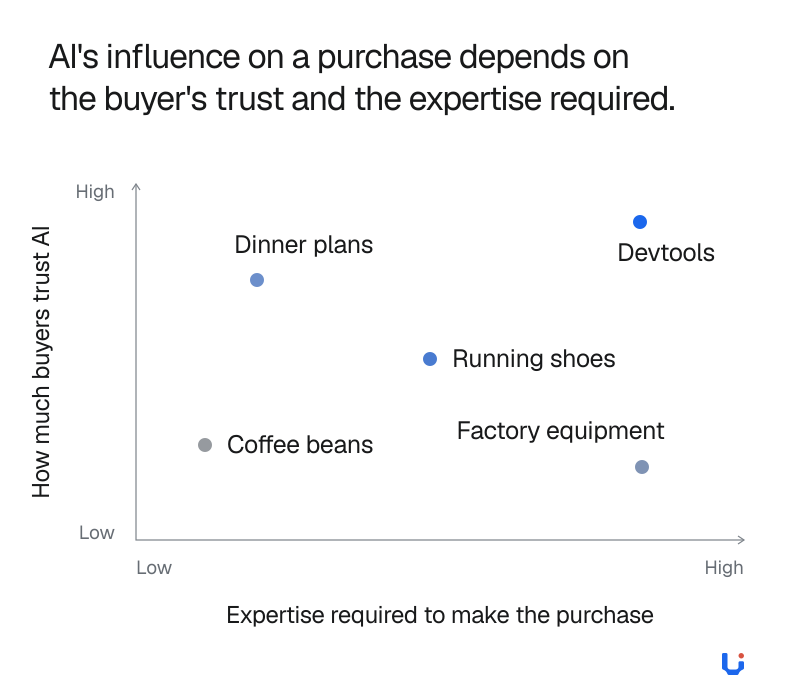
Devtools illustrate what happens when both factors are present. A developer may trust a coding agent to choose a library in an unfamiliar area, giving AI substantial influence over the selection. The same developer may want little advice on tools they already know well.
If you want to figure this out for your business, you can begin by asking buyers (a) whether they used AI during their evaluation process and (b) what they discussed. Their answers can tell you which decisions AI helped shape and which concerns it raised. Those are useful starting points for understanding the audience you now need to persuade.